
Tooth Eruption Chart and Timeline
If you’re a child or teenager, chances are you’ve had at least one tooth grow in. Although this is certainly nothing to fear, it can nonetheless be startling and disorienting when suddenly there’s a new tooth poking out the next day. In the meantime, though, there are a few things that parents should know about how teeth get in and stay in place. In this article, we’ll look at the teeth eruption chart and timeline, the stages of tooth development, and how teeth form.
It’s important to note that not all children will follow a typical tooth eruption timeline. One child may have their first tooth erupt earlier than another child. Differing timelines occur because of the differences in how each child’s jawbone behaves and develops. For example, your jawbone is different from your sibling’s and your mother’s and father’s jawbone.
What Is a Tooth Eruption Chart?
A tooth eruption diagram is nothing more than a graphic representation of the process of tooth development. It shows how the teeth come into your mouth and how long it takes for each tooth to grow.
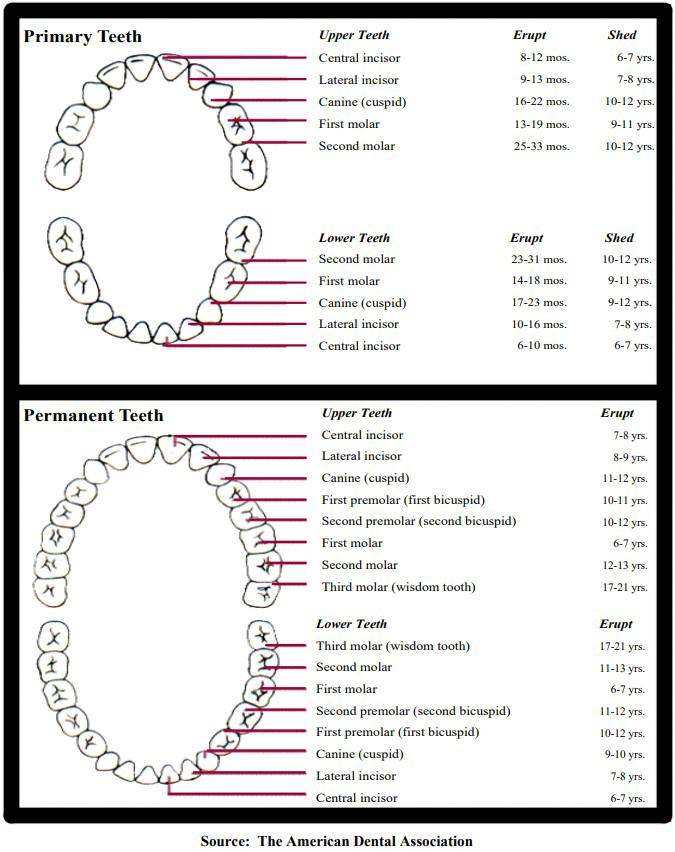
A tooth eruption chart can be seen as a timeline, and this is the chart’s original purpose. However, establishing and observing the patterns displayed within your child’s tooth eruption chart can provide valuable information about the onset of childhood teeth and point to potential issues in the future.
Stages of Tooth Eruption
Before we look at the timeline of tooth development, let’s look at each stage of tooth eruption. The first two stages are the pre-eruptive stage and the eruptive stage. These stages help determine how long it takes for a child’s first primary teeth to emerge.
Pre-eruptive Stage: During this stage, the primary teeth form, and they are in an embryonic or “non-erupted” form. During this phase, the tooth germs are growing within the jawbone, and they have more room to spread out as the child’s bones grow. Primary teeth begin forming at five months and usually finish erupting by 33 months.
Eruptive Stage: Once a tooth has begun to develop within your child’s mouth, it will progress into the eruptive stage. During this stage, the tooth begins to push its way through the gums. It may have tiny creases or indentations on its surface as it makes its way through the gums to make space for itself. The period of time between the pre-eruptive and eruptive stage can vary from child to child. However, your child’s first primary tooth is likely to become visible sometime during their first year of life.
Every primary tooth will rarely come through simultaneously. One child may have all of their teeth erupt by three, while another child may not have all of their first teeth until five. The pre-eruptive and eruptive stages help define how long it takes for your child’s first primary tooth to emerge.
Primary Teeth Eruption Timeline
The primary teeth eruption timeline is a graphic depiction of the sequence in which each tooth erupts in your child’s mouth. Your child may not follow the average regime, but with the proper monitoring and guidance, it won’t matter. What matters most is that you can spot any changes and communicate with your child’s dentist about what’s happening.
Incisors (8 teeth): The first tooth to erupt is your child’s lower central incisor, followed by the upper central incisor. These are the two front teeth located next to each other in the middle of your child’s mouth. These teeth usually appear six months before a child’s first birthday and are usually fully erupted within 18 months. Your child’s canines (4 teeth) usually erupt at the same time as their incisors, but they may be slightly behind them. The lower canine (the tooth just below your child’s incisor) usually erupts last. Your child’s first molars (6 teeth) usually erupt between 3 and 5 years.
Permanent Teeth Eruption Timeline
Unlike the primary teeth, which come in and out of your child’s mouth as needed, permanent teeth will take longer. Unlike the primary teeth, the first molar usually emerges first. The eruption of your child’s first premolar (1 tooth) usually occurs between 18 months and three years. Your child’s second molars (4 teeth) usually start to emerge between 5 and 6 years. The eruption of second premolars (2 teeth) usually starts around age seven years or older.
An eruption timeline is a valuable tool for identifying any signs that a child’s teeth are not developing in the way they should. However, keep in mind that the vernacular terms used to describe the various dental stages are not as meaningful as the actual physical signs you will see. The most commonly used descriptors for tooth development include early, late, and delayed.
If you have questions about your child’s teeth and live in Southeast Michigan, please contact your nearest Fortson Dentistry location to set up an appointment.

Fortson Dentistry’s staff provides high-quality dental services to our patients in Southeast Michigan from our five locations.